How Automation Improves the Entrepreneur’s Mental Health

If you only have 1 minute, read this

The real bottleneck in your company is not a lack of capital or talent; it is the saturation of your working memory. The cognitive load required to remember follow-ups, pending invoices, and small operational details generates background noise that consumes your strategic energy. At Hebra Studio, we understand that the highest cost of bureaucracy is not the time it takes to execute it, but the chronic stress of having to hold it all in your mind.

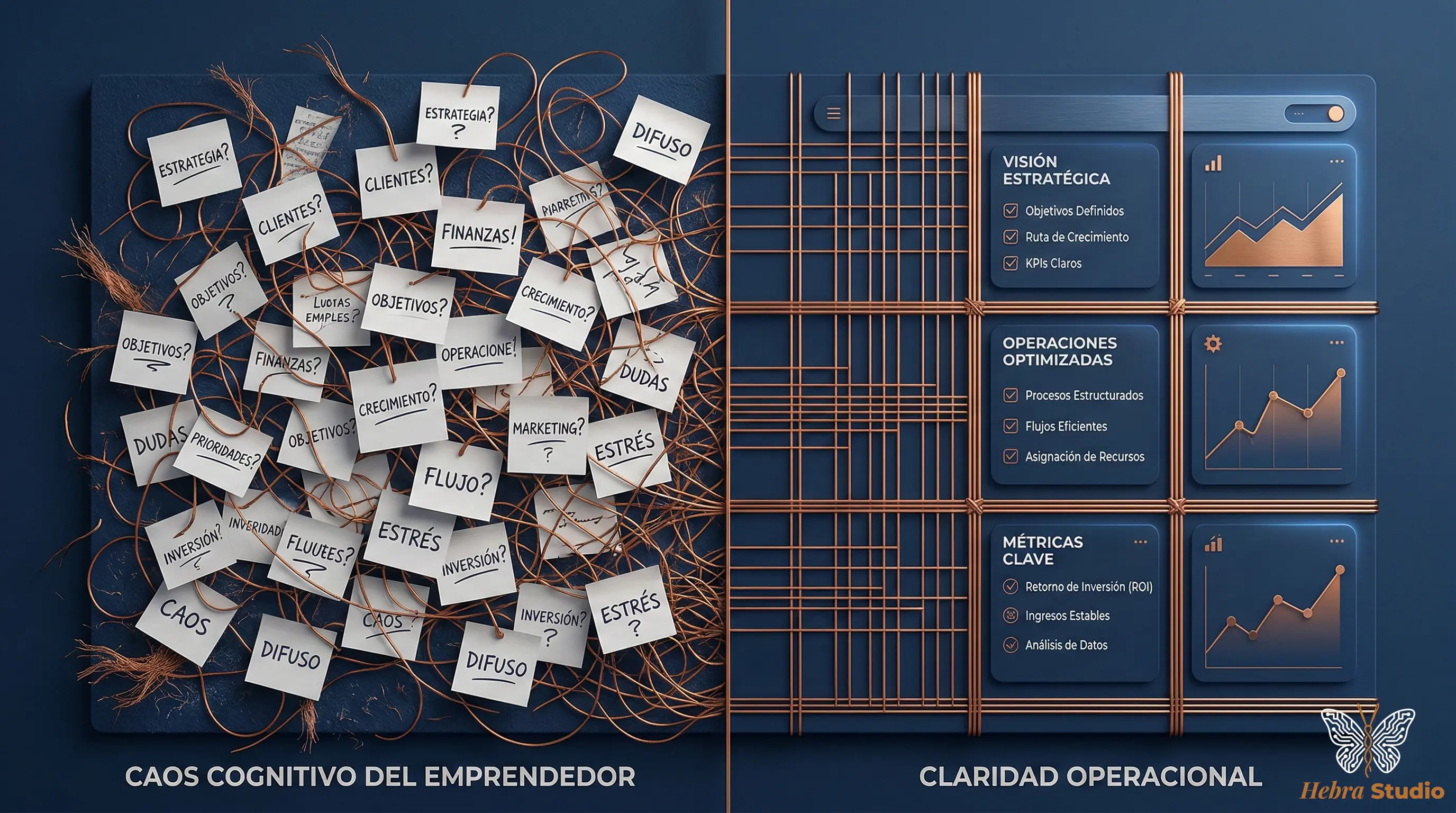
In this analysis, we break down how implementing a digital “second brain”—a structured network of automations and databases—acts as a silent system that absorbs the weight of daily operations. Externalizing technical memory to robust systems is not just an efficiency decision; it is a direct intervention in the emotional well-being of the executive. By untangling the knots of routine work, you recover the mental space needed to fulfill your true function: your time is for leading, not for operating.

The Invisible Cost of Leadership: How to Untie the Knot of Cognitive Load

There is a particular kind of fatigue that does not come from the hours worked, but from the number of loose threads you hold in your mind. It is that silent exhaustion that appears on a Tuesday at six in the evening, not from having made major decisions, but from having had to remember small tasks.

“Did we send the signed contract to this client?”, “Did we follow up on last month’s invoice?”, “Did I notify the team about the change in the project?”. If these questions circle your head while you try to design next quarter’s strategy, your company has a structural problem.

In the business ecosystem, the emotional well-being of the founder is rarely discussed as a business metric. However, at Hebra Studio we know, speaking from executive to executive, that an operationally saturated leader is a leader with compromised vision.

The Anatomy of Cognitive Load in Management

Cognitive load (the mental effort required to process information at any given moment) has a rigid limit. When you use your brain as a hard drive to store reminders and pending tasks, you are subtracting capacity from your main processor: strategic reasoning.

In the technical realm, this phenomenon is called a memory leak. It occurs when a software program does not release memory it no longer needs, slowing down the entire system until it crashes. Your mind works in an identical way.

Every undelegated task, every manual process, and every post-it stuck to the edge of your monitor acts as a background program consuming your resources. This state of constant alert is the perfect recipe for chronic stress and decision fatigue.

You are not exhausted from leading your company. You are exhausted from managing it by sheer memory.

The Digital “Second Brain”: A Bespoke Operational Workshop

The solution is not about working more hours, or even about hiring more staff who add noise to communication. The solution lies in structuring silent systems.

This is where the concept of a digital “second brain” comes into play. In simple terms, it is an ecosystem of connected tools that capture, organize, and execute information without you having to intervene.

It is the difference between hand-weaving every garment and designing a mechanical loom that does it for you with millimeter precision.

When we externalize these processes at Hebra Studio, we apply the principles of Artisanal Engineering. We do not install generic software that forces you to adapt to it. We analyze the knots in your daily operations and design a workflow (an automatic sequence of tasks) that is tailored to the exact measure of your business.

  • Automated capture: A client approves a quote and, without you lifting a finger, the system generates the project, notifies the team, and schedules the first invoice.

  • Silent follow-up: The system remembers when to follow up on a cold lead and presents the task to you only at the moment you need to make the decision, not three weeks early.

  • Single source of truth: No more searching through five different tools to find out the status of a project. Data flows to a single, ordered, and serene dashboard.

From Burnout to Clarity: Evidence from the Trenches

The promise of automated systems usually focuses on saving money. But the true return on investment (ROI) is emotional.

We have audited operations where executives were operating on the edge of burnout. One of our clients, the CEO of a mid-sized consultancy, spent his weekends reviewing crossed inboxes to make sure nothing had “fallen through the cracks”.

After untangling his operational chaos and structuring an automated Customer Relationship Management (CRM) system—a smart database that tracks every interaction with clients—the change was drastic.

The testimonial did not speak of increased revenue (which there was), but of regaining sleep. “For the first time in three years, I closed my laptop on a Friday knowing the system would hold the business together until Monday. My mind was finally silent,” he told us.

This is the real impact of well-applied technology. Eliminating friction work reduces anticipatory anxiety. Trust in a robust system is the best antidote to founder stress.

The Elegance of Silent Systems

A good technological system should be like a good suit of clothes: you don’t notice the seams, you only see how the garment enhances the figure.

In the B2B world, noisy tools abound, full of notifications, red lights, and incomprehensible jargon. In our workshop, we champion operational sobriety. A system should only alert you when there is an anomaly or when your human and strategic judgment is required.

The rest of the time, the system should be invisible. It should process data, move files, update databases, and send follow-up emails from the shadows, in absolute silence.

This is the true reduction of cognitive load. You don’t have to interact with the tool; the tool works for you.

Recovering Mental Space for What Matters

When you empty your mind of operational clutter, the free space doesn’t stay empty. It is immediately filled with what truly makes a company grow: long-term vision, innovation, and quality in relationships.

  • You have time to sit down and think about new business models.

  • You have energy to mentor your key employees instead of micro-managing them.

  • You have the mental clarity to sit down for dinner with your family without checking your phone under the table.

Untying the knot of daily operations is an act of respect for your own talent and your mental health. Chaos is not a sign of success; it is a symptom of an immature system.

Your Quick Win for Today

You don’t need to implement the entire infrastructure tomorrow. Start by emptying your short-term memory.

The Thread Unloading Exercise (15 minutes):

  1. Take a sheet of paper (step away from screens).

  2. Write down all the repetitive tasks, follow-ups, and “things to remember” that you currently have in your head. Without filtering.

  3. Choose only one of those repetitive tasks (e.g., “Send welcome emails to new clients” or “Follow up on unpaid invoices”).

  4. Find out how to automate only that task this week. You can use a basic rule in your email or document the step-by-step process to immediately delegate it to a team member.

Take that single thread out of your head. Feel the slight relief it produces. That is the beginning of true operational freedom. Because remember our promise: Your time is for leading, not for operating.

Want to explore how automation could solve the most costly knot in your operations?

Request a Free Diagnosis