Producing During Ghost Hours: The Answer to the Reduced Workday

If you only have 1 minute, read this

The social and regulatory pressure to reduce the workday has ceased to be a theoretical debate and has become a real operational tension for SMEs. While large corporations cushion this impact with resource surpluses, the average business owner faces an apparently impossible equation: how to maintain or increase production while reducing available man-hours, without this implying sacrificing their own personal life in the attempt?

This Hebra Studio analysis does not explore how to “work faster,” but how to restructure the architecture of your business. We address how to design silent systems that operate during “ghost hours”—nights and weekends—to definitively decouple revenue from physical presence. It is essential reading for understanding how to transform the demand for flexibility into a competitive advantage for talent attraction (Employer Branding), rather than perceiving it as an unaffordable cost.

How artisan process engineering enables boutique businesses to thrive under the pressure of working fewer hours.

The debate about reducing the workday is on the table. Whether through the implementation of the four-day work week or regulatory adjustments aimed at compressing weekly hours, the wind is blowing toward less physical presence in the office.

For the HR director of a multinational, this is a complex logistical puzzle. For the founder of an SME or boutique business, it feels like a direct threat to the company’s bottom line.

There is a deeply rooted belief in the business fabric: productivity is directly proportional to hours spent at a desk. If we reduce the time, we reduce the result. This mindset, understandable in the industrial era, is a drag in the digital economy.

At Hebra Studio, we analyze this with the coldness of data. The reality is that SMEs face the challenge of remaining competitive with fewer human hours available. Trying to compensate for this reduction by asking the team to “run faster” only leads to burnout and error.

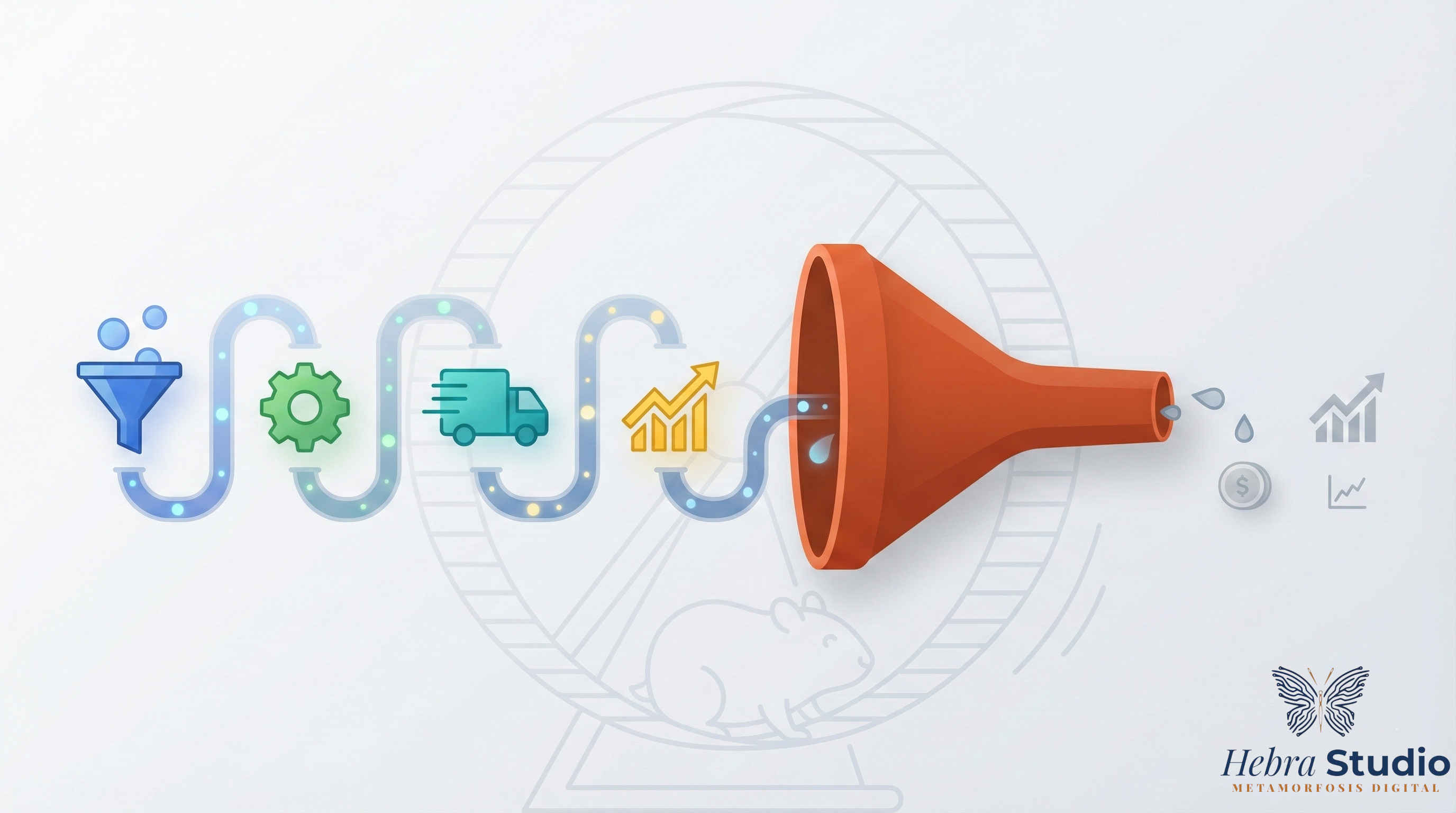
The solution is not human speed; it is systemic structure. It’s time to untangle the knot of time dependency.

The New Landscape: When “Fewer Hours” Is Non-Negotiable

We cannot ignore the context. The pressure is not just legal; it is social and market-driven. High-value talent no longer negotiates only salary; they negotiate time.

If your company requires a brilliant person to spend four hours a day moving data from a spreadsheet to a CRM, that person will leave. And if your company requires you, as founder, to personally supervise those four hours to ensure there are no errors, the one who will end up “burned out” will be you.

Operational rigidity is today a toxic liability. Flexibility is not an optional “social benefit”; it is an operational requirement for the medium-term sustainability of the business.

The Solution Is Not to Run Faster, It’s to Decouple Operations

This is where artisan engineering applied to digital processes comes in. Our approach at Hebra Studio is not to implement software massively. It is to understand the unique fibers of your business and weave a custom solution that absorbs the operational load.

The strategic objective is to decouple task execution from the human workday.

If a process requires judgment, creativity, or empathy, it must be done by a person during their optimal schedule. If a process is repetitive, based on fixed rules and data handling, it must be done by a system, regardless of what the clock says.

The Concept of “Ghost Hours”

Automation does not sleep. This is its most fundamental and least exploited value.

We call “ghost hours” that vast stretch of time from when your last employee closes their laptop on a Friday at 3:00 PM until the first one opens it on Monday at 9:00 AM. These are nights, early mornings, and weekends.

A traditional business stops its productive machinery during those hours. A business with a robust automation architecture uses those ghost hours to execute the heavy work.

Imagine a workshop that keeps weaving through the night, without noise, without supervision, so that at dawn the work is ready for the master artisan’s review. That’s what we do with data.

Artisan Engineering Applied to Workflow

What does this mean in daily practice? It means building systems that handle the bureaucracy while the team rests.

Let’s look at concrete examples of how automation absorbs the workload during non-productive hours:

  • Overnight Database Synchronization: Instead of having an administrative assistant cross-checking stock between your e-commerce and your ERP (enterprise resource planning system) during the morning, a “bot” performs the synchronization at 3:00 AM. When the team arrives, the data is accurate. Zero human errors, zero man-hours invested.

  • Status Report Generation and Delivery: Every Friday afternoon, your system can compile the week’s performance metrics, lay them out in an elegant PDF, and deposit them in your inbox and your clients’ inboxes so they’re ready Monday morning. Nobody had to stay late on Friday to “close the week.”

  • Lead Triage and Pre-processing: A potential client from another time zone fills out a form on a Saturday. An automated system can instantly qualify them based on their responses, enrich their data by searching for public information about their company, and assign them to the appropriate salesperson’s calendar for Monday at 10:00 AM, even sending them an immediate personalized welcome email.

By moving these tasks to “ghost hours,” the reduction of human work hours ceases to be a productivity loss problem and becomes a resource optimization. The human team works fewer hours, yes, but 100% of those hours are high value-added.

The Strategic Side Effect: Employer Branding

There is a critical collateral benefit in the war for talent.

According to recent studies from leading employment platforms, up to 95% of professionals indicate that flexibility and work-life balance are decisive factors when considering a job offer or staying with a company.

An SME that depends on manual processes and rigid attendance cannot offer this flexibility genuinely. When they try to offer remote work, it becomes a chaos of constant calls and lack of control.

Well-structured automation is the infrastructure that makes real flexibility possible. It’s not just an efficiency tool; it is your most powerful Employer Branding tool.

By having robust systems that don’t depend on constant surveillance, you can offer your team the autonomy they demand. You go from being an “outdated” company that controls schedules, to a “boutique” company that manages by objectives and trusts its systems. You will attract and retain better professionals.

The Invisible Return: Your Time as a Business Owner

Finally, let’s talk about you. From boss to boss.

Hebra Studio’s promise is clear: “Your time is for leading, not for operating.”

The resistance of many founders to automation is usually not economic, but a false sense of loss of control. There is a paradoxical tranquility in seeing the chaos with your own eyes and feeling that you are “managing” it by putting out fires manually.

But that operational chaos is the chain that ties you to micromanagement and prevents you from thinking strategically.

If the pressure to reduce the workday gives you anxiety, it is a clear symptom that your business depends too much on your presence and that of your team for the wrong tasks. Automating is building a system of trust. It is knowing that the workshop continues to operate with millimeter precision even when you’re not watching.

It is reclaiming your right to disconnect, knowing that your business doesn’t.

Your Quick Win for Today

To wrap up, an actionable tip you can apply today without writing a single line of code.

The 15-Minute Repetitive Task Audit.

During the coming week, ask your team (and do it yourself) to note down on a simple list any task that meets two criteria:

1. It takes less than 15 minutes to execute.

2. They repeat it more than 3 times a day, every day.

Typical examples: Copying data from an email to a spreadsheet; downloading an invoice from a supplier portal and saving it to a Drive folder; sending the same “received, we’ll look into it” confirmation email.

At the end of the week, collect those lists. You’ll be surprised to discover that 30% or 40% of your team’s workday dissolves into these micro-tasks.

That list is your treasure map. Those are the first tasks a content architect should automate. Start there. Untangle that first thread.

Want to explore how automation could solve the most costly knot in your operations?

Request a Free Diagnosis