
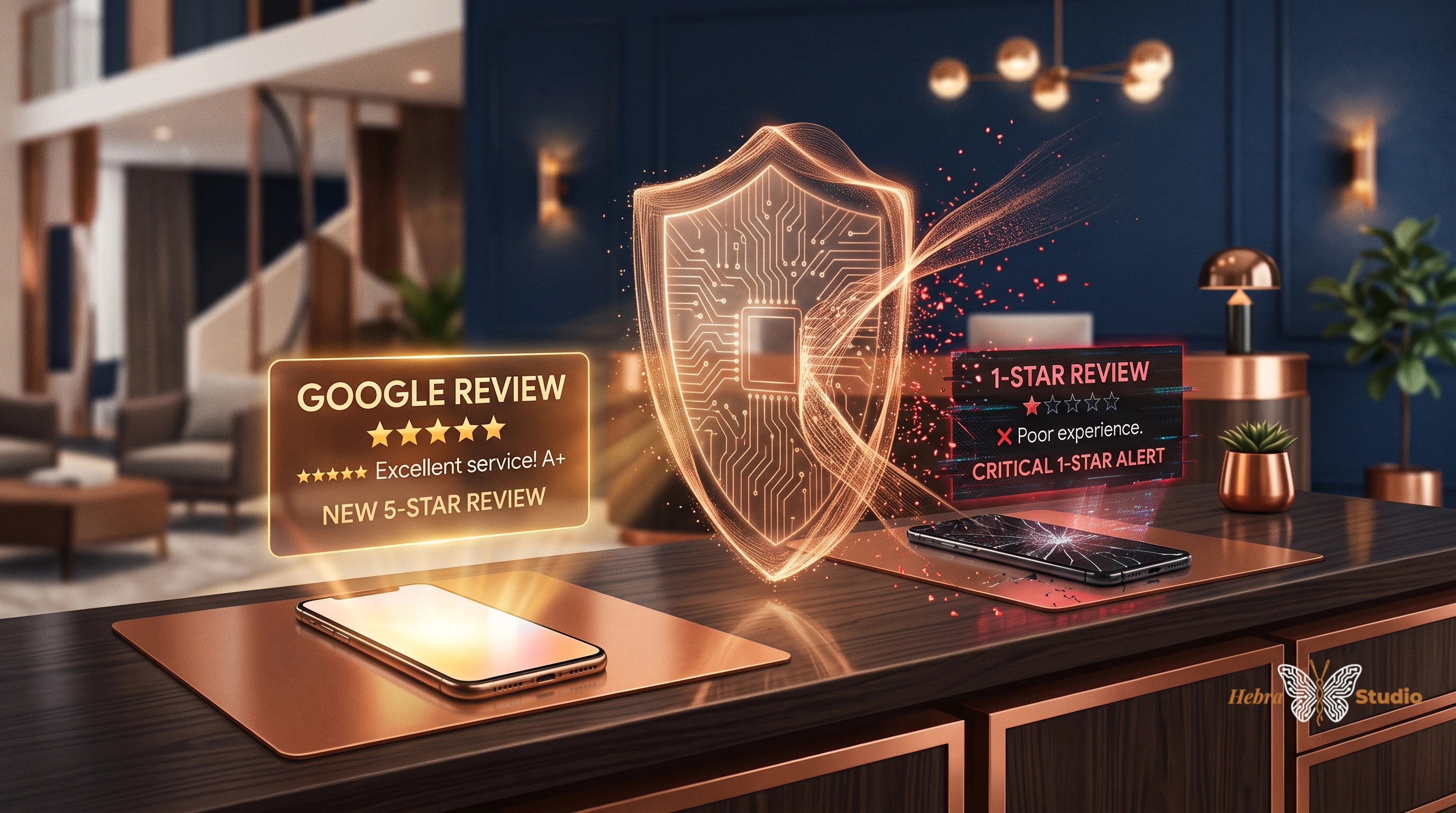
The Mistake 90% of Businesses Make with Google Reviews (And the Automation That Fixes It)

If you only have 1 minute, read this

87% of negative Google reviews come from clients who never complained in person. Most businesses ask for reviews randomly — or don’t ask at all. Satisfied clients leave silently while unhappy ones post their 1-star review. There’s an automation pattern that reverses this: ask about satisfaction privately before requesting a public review.

The mistake 90% of businesses make with Google Reviews

Your business has 4.2 stars on Google. Not bad. But it’s been months since anyone left a new review. Or worse: the last review is 1 star, and you have no idea who left it or why.

If this sounds familiar, you’re not alone. According to BrightLocal, 87% of consumers read online reviews before visiting a local business. And the pattern of negative reviews follows a rule few business owners know:

The silence rule

A Harvard Business Review study found that dissatisfied clients are 2 to 3 times more likely to leave a public review than satisfied ones. The happy client walks away and doesn’t think about you again. The frustrated one gets angry, opens Google Maps, and writes their complaint with all the indignation they have left.

This isn’t a quality problem. It’s an information flow problem.

What businesses do (and why it doesn’t work)

We’ve seen three common patterns in businesses trying to manage their reviews:

Pattern What they do Result
The one that asks nothing No system. They wait for clients to leave reviews on their own initiative. 3–4 reviews per year. The last one probably negative.
The one that asks everyone They send the same message to everyone: “Would you leave us a Google review?” 30% of unhappy clients leave a public review. Happy ones don’t respond.
The one that only asks at the end They ask for reviews when closing a sale or treatment. No prior filter. Mixed: depends on the client’s mood that day.

The problem isn’t intention. It’s system architecture. All these patterns have a blind spot: they have no intermediate filter. They don’t ask how the client feels before deciding where to send them.

The pattern that works: the satisfaction filter

The right automation isn’t “ask for more reviews.” It’s ask privately first, then act. Here’s how it works:

Review protection system flow

  1. Private question: The day after the appointment, the system sends a WhatsApp or SMS: “Hi [name], how was your visit yesterday? On a scale of 1 to 5.”
  2. Automatic filter:
    • Response 4 or 5 → The system replies: “Great to hear! Would you help us by leaving a Google review? Here’s the link: [link]”
    • Response 1, 2, or 3 → The system replies: “We’re sorry we didn’t meet expectations. Tell us what we can improve: [link to private form]”
  3. Result: Happy clients leave positive reviews. Unhappy ones give feedback privately, where you can act before it reaches Google.

A dentist, a lawyer, an auto repair shop, a hair salon — they all lose the same thing when they don’t have this filter: control over their online reputation.

Why automation isn’t an “extra”

You can do this manually. Some businesses try: the receptionist sends messages the next day. But there are three problems:

1. It gets forgotten. They have 40 other things on their mind. Reviews are the first thing dropped when there’s pressure.

2. It’s inconsistent. One day they ask everyone, the next only the ones they like. The system needs to be the same for every client.

3. No follow-up. If the client doesn’t respond to the first message, nobody sends a second. An automated system can retry 48 hours later.

A silent automation system solves all three at once. It’s not a chatbot that replies with generic phrases. It’s a flow that asks, filters, redirects, and follows up — all without your team lifting a finger.

The impact on your reputation

Local review data (2025–2026)

  • 49% of consumers need at least 4 stars to consider a business
  • Reviews account for 17% of Google ranking factors
  • A business with 10+ recent reviews receives 2.7 times more clicks than one with fewer than 5
  • 73% of consumers only read reviews from the last 4 weeks

Source: BrightLocal Local Consumer Review Survey 2025 and Google Business Profile documentation.

This means something concrete: you don’t need hundreds of reviews. You need a steady flow of 2–4 positive reviews per month. That’s enough to keep your profile fresh and above the 4-star threshold.

The cost of not having a system

Impact Data
Potential client loss One less star on Google can mean a 5–9% revenue loss
Conversion effect 94% of consumers have avoided a business due to recent negative reviews
Recovery cost Getting a dissatisfied client to change their review is nearly impossible
Frequency 1–2 star reviews are written 3 times faster than 5-star reviews

An automated review protection system isn’t a luxury. It’s an investment in controlling an asset Google uses to decide whether your business shows up first or on the second page.

What this system is NOT

What we DON’T do

  • We don’t fabricate reviews. Fake reviews violate Google’s policies and can result in your business profile being removed.
  • We don’t suppress negative reviews. What we do is filter who sees the public review link.
  • We don’t promise a specific star rating. The system improves information flow. Results depend on the actual quality of your service.

Your Quick Win for today

Your Quick Win for today

Before automating anything, try this experiment: open Google Maps and search for your business. Check the date of the last review. If it’s more than 3 months old, you have a flow problem. If the last one is negative, you have an urgent problem.

Next, count how many reviews you have from the last 90 days. If fewer than 3, your profile is losing visibility every week.

The experiment costs nothing. It just gives you real data on the state of your online reputation.

The next step

A review protection system isn’t a plugin you install in 5 minutes. It needs integration with your booking system, personalised messages by business type, a follow-up flow adapted to your schedule, and a dashboard where you can see what’s happening without checking Google Maps every morning.

That’s bespoke engineering. And that’s exactly what we do.

Want to know how your online reputation stands today?

Request a Free Assessment