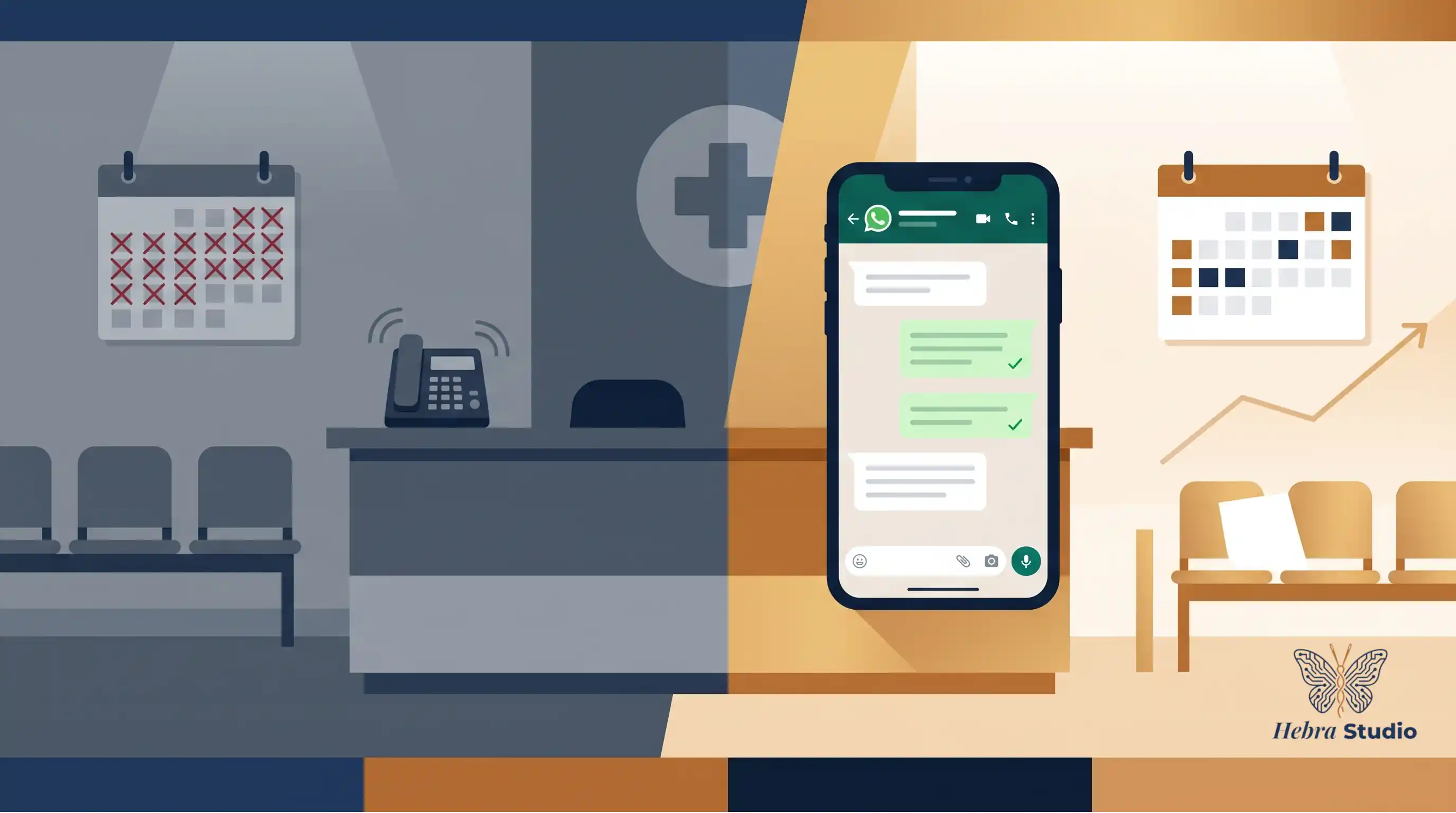
Your clinic has between 150 and 300 patients who haven’t returned in over 12 months. They didn’t leave because of bad service — nobody simply asked them to come back. With 200 dormant patients and an average ticket of 60 €, that’s 12,000 € a year sitting in your database that nobody’s collecting. An automated system can reactivate between 16 and 30 appointments in 10 days, without anyone on your team touching the phone.
The invisible problem: patients who “left” without leaving
In the daily life of a clinic, the team focuses on patients who show up. The ones who call, the ones who book online, the ones who walk through the door. But there’s a much larger group that simply stopped appearing — no complaint, no notice, no apparent reason.
These patients aren’t “lost” in the traditional sense. They didn’t leave for a competitor because of bad service. Most simply finished their treatment and didn’t need to come back yet, changed their routine and forgot, or were waiting for a call that never came.
The cost of this inaction doesn’t appear in any report. There’s no invoice that says “today you missed out on 3,000 euros because you didn’t contact 50 patients.” But the money slips away every month, in silence.
Manual reactivation: why it doesn’t work
Some clinics already try to reactivate patients. Here’s how they do it:
A receptionist reviews the schedule on Friday afternoon. Looks for names they haven’t seen in a while. Calls three or four. Two don’t answer. One says “I’ll call back.” The fourth hangs up before the introduction is over.
Three hours of work. Zero appointments booked. And on Monday, the schedule looks exactly the same.
The problem isn’t intention. The problem is scale. You can’t call 200 people one by one. And if you try doing it on WhatsApp manually, each message takes 3 minutes: find the number, write the personalised text, wait for a response, manage the appointment. That’s 10 hours for 200 patients.
Nobody has 10 spare hours in a clinic.
The automatic flow: 200 messages in 10 days without touching the phone
Picture this: every day, Monday to Friday, your system automatically sends 20 WhatsApps to patients who haven’t visited the clinic in over 12 months. Each message includes the patient’s name, the treatment they received, and a direct invitation to book.
If the patient replies “yes” or “I want an appointment,” the system offers them an available slot. If they reply “no” or “not now,” it logs it and retries in 3 months. If they don’t respond within 48 hours, it sends a shorter follow-up message.
Nobody on your team did anything. Not a single call. Not a manual message. Not a schedule lookup.
The flow works with three pieces:
- The patient list. You export from your clinical software (or even from a spreadsheet) the patients who haven’t had an appointment in the last 12 months. Name, phone, last treatment, last visit date. Four columns.
- The sending engine. A tool like n8n — open-source software, installs on any server, doesn’t charge per message — reads the list, selects 20 patients per day, and sends each one a personalised WhatsApp at 10:00 in the morning.
- The response handler. When the patient responds, the system interprets the reply: if positive, it opens a booking flow. If negative, it flags it for future retry. If ambiguous, it routes to a human.
All of this happens without anyone at the clinic opening WhatsApp, checking responses, or spending a single minute on reactivation.
The numbers: how much can you recover?
Figures vary by sector, but the data observed in clinics that implement automatic reactivation systems is consistent:
Simulation: 200 dormant patients, average ticket 60 €
| Stage | Calculation | Result |
|---|---|---|
| Messages sent | 20/day × 10 days | 200 |
| Read (30–45%) | 200 × 0.375 | ~75 |
| Appointments booked (8–15%) | 75 × 0.12 | 16–30 |
| Revenue recovered | 22 appointments × 60 € | ~1,320 € |
| Monthly projection (2 batches) | 1,320 € × 2 | ~2,640 €/month |
Conservative figures for dental, physio, aesthetics or veterinary clinics with 200+ patients without an appointment in 12 months. Actual range depends on database quality and sector.
This isn’t a marketing campaign. You’re not paying for ads. You’re not looking for new patients. You’re collecting what was already yours.
What changes when you reactivate automatically
The benefit isn’t just money. It’s what stops happening:
Your receptionist stops wasting Friday afternoons calling patients who don’t answer. Your schedule stops having unexplained gaps on Tuesdays and Wednesdays. Your team stops feeling like “there are no clients” when in reality there are 200 that nobody contacted.
And there’s a side effect nobody mentions: when a patient who’s been gone for a year receives a personalised message that references their last treatment, they perceive that the clinic remembers them. That’s not cold automation. That’s customer care at scale.
“But I already have management software”
Having a program that stores your patients’ data isn’t the same as having a system that contacts them when they leave. Most clinical software is advanced databases: they store information well, but they don’t alert you when a patient hasn’t shown up in 12 months.
The difference is like the one between a filing cabinet and an assistant who says: “Hey, these 50 patients haven’t been back in a year. Should I write to them?” The filing cabinet stores. The system acts.
Your Quick Win for today
Open your patient database. Filter by “last visit more than 12 months ago.” Count how many there are. Multiply by your average ticket (if you don’t know it, use 60 €). That number — probably between 9,000 and 18,000 € — is what your clinic is leaving on the table every year. Now divide by 12: that’s what slips away each month. The question isn’t whether you can afford a reactivation system. The question is whether you can afford to keep going without one.
How many dormant patients does your clinic have waiting for someone to write to them?
Request Free Diagnosis